When dealing with Japanese we should be aware of one concept central to how organizations function which is wa (和) or literally the principle of harmony.
At first glance, wa may appear to be simply about “getting along” or to be incongruence with our surroundings. However, in practice, it is much deeper. It is a social system that shapes how decisions are made, how meetings are conducted, how disagreements are managed, and how people work together daily.
In a world where business is often dominated by speed, assertiveness, and individual achievement, the Japanese concept of wa offers an alternative philosophy: collective stability over individual dominance.
Interestingly, many aspects of this philosophy resonate strongly with Islamic principles, although their foundations and priorities differ.
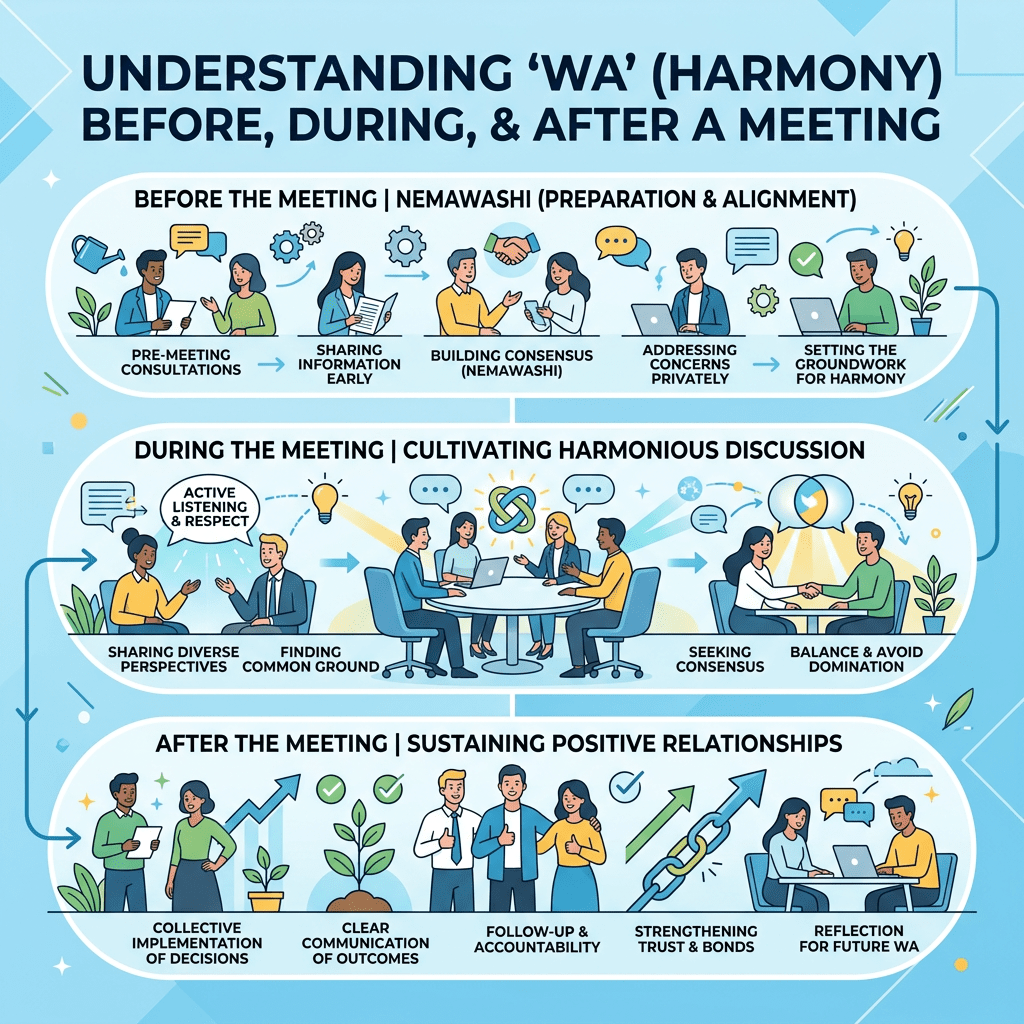
Understanding Wa: Harmony as an Organizational Philosophy
In Japanese culture, wa means preserving balance in relationships and maintaining social cohesion. In business, this means reducing unnecessary confrontation, respecting hierarchy, and prioritizing group alignment rather than individual self-interests.
Decision-Making: Consensus Before Action
One of the clearest examples of wa in business is consensus decision making before meeting. Japanese companies emphasize nemawashi — informal consultations before formal meetings — so that affected people understand issues and potential decisions in advance. The process follows the concept of: Slow in decision, strong in execution.
Meetings: Alignment Over Debate
In Japan, meetings often function differently. Open disagreement is softened. Silence carries meaning. Listening is as important as speaking. Instead of saying “No,” one might say “That may be difficult” — relational intelligence that preserves working relationships for the long term.
Daily Work Conduct: Discipline as Social Respect
Punctuality is strict in Japan because being late disrupts group flow. Employees are expected to “read the air” (kuuki wo yomu) — understanding unspoken expectations, moods, and contextual signals. It creates a high-trust, high-context environment.
Conflict Management: Quiet Correction, Preserved Dignity
Conflict in Japanese organizations is handled privately. Correction is discreet. Feedback is softened. Face-saving matters — protecting dignity and preserving long-term cooperation.
Where Japanese Wa Meets Islamic Principles
Islam places strong emphasis on consultation (shura), unity (ukhuwwah), good manners (adab), and preserving social bonds. The Qur’an says: “And whose affairs are conducted by mutual consultation.” (Surah Ash-Shura 42:38)
The Prophet Muhammad ﷺ said: “The believer to another believer is like a building whose different parts support each other.” (Sahih al-Bukhari)
One Important Difference
In Japanese wa, harmony itself is often the primary goal. In Islam, harmony is important — but truth and justice come first. The Prophet ﷺ said: “The best jihad is speaking a word of truth to a tyrannical ruler.” Harmony must never silence truth.
Conclusion
From Japan, we learn and practice how to preserve harmony.
From Islam, we learn and practice why harmony must serve truth.
Combined, they offer a powerful framework for ethical and sustainable leadership in today’s world.
Related Posts
- High-Context Communication in Japan: A Cultural Insight
- Understanding Hard-working vs Working Hard in Japan
- Monozukuri and Itqan: What Islam and Japan Teach Us About Excellence
Enjoyed this post? Subscribe to receive new articles on Japan, quality, leadership, and education — straight to your inbox.


Leave a Reply