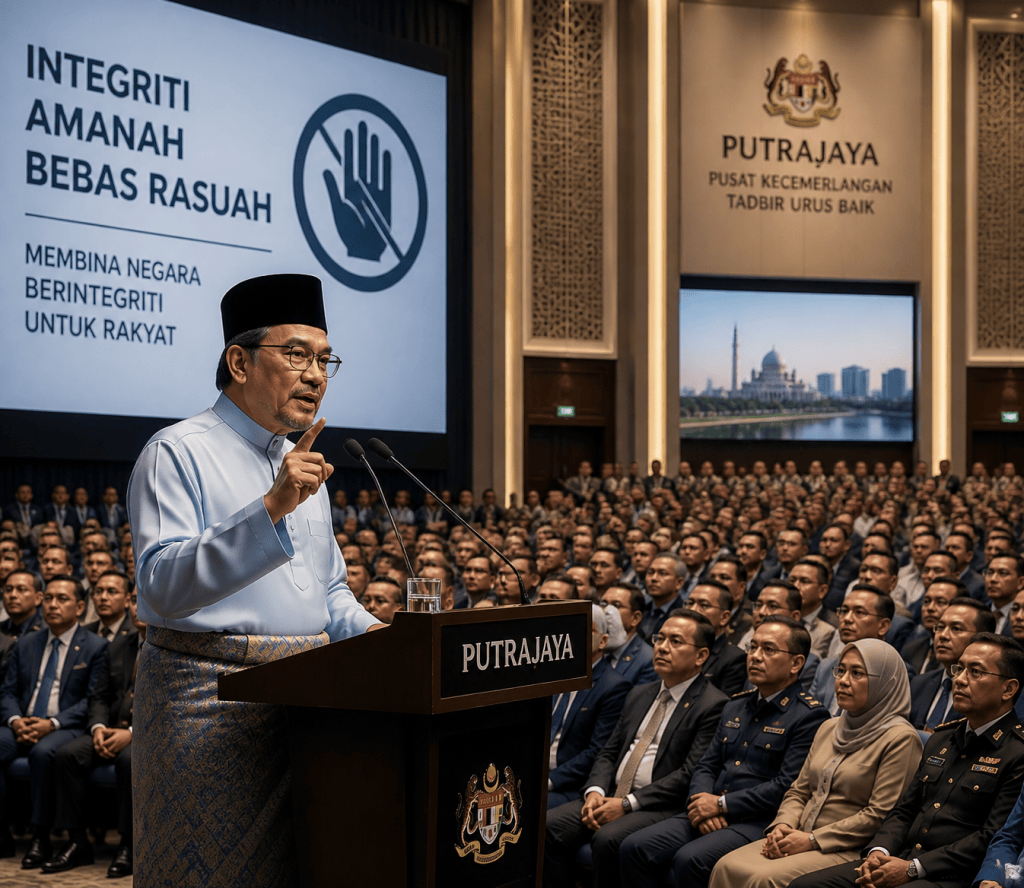
We are not short of capable and intelligent leaders. Many of today’s leaders are well educated, articulate, media-savvy and strategically skilled. Yet across countries, companies and communities, people say the same thing: we do not trust them. The problem is rarely competence. The problem is character.
In Islamic tradition, the question “who is the best leader?” has a clear answer. The Prophet Muhammad ﷺ is described in the Qur’an as uswatun hasanah, the excellent example (33:21). Among those who came after him, Umar ibn al-Khattab is held up as the model of just and accountable governance. Classical scholars summarised the Prophetic qualities as siddiq (truthful), amanah (trustworthy), tabligh (open in communication) and fatanah (wise and competent). Notice that three of the four are about character, and only one is about skill.
Measured against this standard, four gaps stand out in today’s leadership.
1. Integrity: saying one thing, doing another
The biggest gap is consistency between words and actions. Leaders promise transparency and then hide information. They preach sacrifice while enjoying privileges. They apply rules strictly to others and loosely to themselves and their allies. Increasingly, integrity is treated as image management: the goal becomes appearing clean rather than being clean.
The Qur’an addresses this directly: “Why do you say what you do not do?” (61:2). Umar ibn al-Khattab is reported to have held his own family to a stricter standard than ordinary citizens, precisely to close this gap between word and deed.
2. Corruption: power seen as a prize, not a trust
Corruption today is less often crude bribery and more often systemic: patronage, contracts for cronies, relatives placed in positions, laws shaped to protect insiders, and money politics to win and keep power. The root is a mindset. Leadership is treated as an opportunity to gain, rather than an amanah that one will be questioned about.
The Prophet ﷺ declined to give positions to those who asked for them eagerly, and warned that leadership would become regret on the Day of Judgment for those who did not fulfil its rights. Many modern leaders also lack the courage to cleanse their own circles, because those around them are often the very people who brought them to power.
3. Trust: broken promises and no accountability
Trust erodes when people see the same three patterns again and again:
- Promises made for elections, forgotten after them.
- No one takes responsibility. Failures are blamed on predecessors, officials or external forces. Resigning over failure has become rare.
- Leaders cannot be questioned. Criticism is treated as disloyalty instead of being welcomed as correction.
Contrast this with the well-known account of Umar being corrected in public by a woman on the question of dowry. He accepted it openly, acknowledging that she was right and he was wrong. A leader who cannot be corrected cannot be trusted.
There is also a practical cost. As Stephen Covey argued in The Speed of Trust, when trust is low everything becomes slower and more expensive: more contracts, more checks, more suspicion. Distrust is a hidden tax on every organisation and every nation.
4. Kindness: distance from the people
Many leaders are physically and emotionally distant from those they lead. People become voters, numbers or “human resources” rather than human beings in their care. This shows in decisions made without feeling their impact on the poor and vulnerable, in arrogance of speech and lifestyle, and in kindness that appears only during campaigns or in front of cameras.
The Islamic ideal is the leader as shepherd and servant. “Each of you is a shepherd, and each of you is responsible for his flock.” Umar is remembered for carrying a sack of flour at night to a hungry family himself, and for saying that if a mule stumbled on a road in Iraq, he feared Allah would ask him why he had not levelled the road. In the West, Robert Greenleaf’s idea of servant leadership arrives at the same conclusion: the leader exists to serve the followers, not the reverse.
Prophetic leadership vs. common modern failures
| Dimension | Prophetic ideal | Common modern failure |
|---|---|---|
| Integrity | Siddiq: words and deeds are one; stricter standards for oneself and one’s family | Image management; double standards for allies and opponents |
| Corruption | Amanah: leadership is a trust to be answered for, not sought eagerly | Power as a prize; patronage, cronyism and money politics |
| Trust | Tabligh and accountability: open communication, accepting public correction | Broken promises, blame-shifting, criticism treated as disloyalty |
| Kindness | Ra’i and khadim: the shepherd and servant who feels the burden of the weakest | Distance, arrogance, and compassion staged for cameras |
The common root
All four failures grow from one root: leaders who feel answerable to no one. No consciousness of God, little sense of accountability to the people, and institutions too weak to hold them in check.
This is why Islamic thought places taqwa (God-consciousness) at the heart of leadership. It is the internal control that works even when no one is watching. Modern governance tries to achieve the same thing externally, through independent courts, a free press, and audit and anti-corruption bodies. Good leadership needs both: inner character, and outer systems that do not depend on the leader being good.
As a quality engineer, I would put it this way: we cannot inspect integrity into a leader after the fact. It must be designed in, through how we choose leaders, how we form them, and how we hold them to account.
Further reading
- John Adair, The Leadership of Muhammad
- Rafik Beekun and Jamal Badawi, Leadership: An Islamic Perspective
- Ali Muhammad As-Sallabi, Umar ibn al-Khattab: His Life and Times
- Al-Mawardi, Al-Ahkam al-Sultaniyyah (The Ordinances of Government)
- Robert K. Greenleaf, Servant Leadership
- Stephen M.R. Covey, The Speed of Trust


Leave a Reply