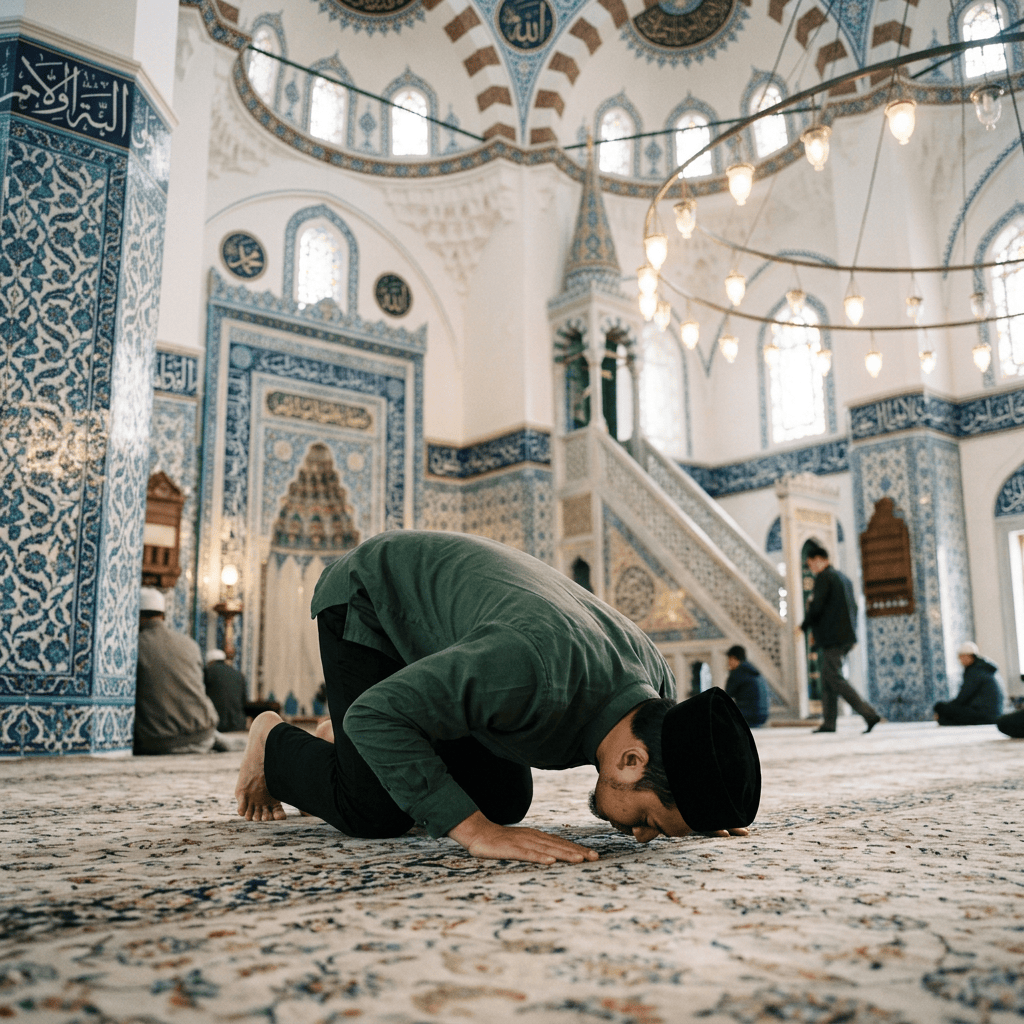
Islam places gratitude, shukr (syukur), at the heart of faith. Japan has built gratitude into its daily language and manners. Looking at the two side by side shows how close they come, and where they point in different directions.
Shukr in Islam
Allah says: “If you are grateful, I will surely increase you” (Ibrahim 14:7), and “Remember Me, I will remember you. Be grateful to Me and do not be ungrateful” (al-Baqarah 2:152). Yet He also observes: “Few of My servants are grateful” (Saba’ 34:13).
Scholars such as al-Ghazali and Ibn al-Qayyim describe shukr in three dimensions:
- The heart: recognising that every blessing comes from Allah (“Whatever blessing you have is from Allah,” al-Nahl 16:53).
- The tongue: praising Him with alḥamdulillāh.
- The limbs: using His blessings in ways that please Him.
The Prophet ﷺ prayed at night until his feet swelled. When asked why, since he was already forgiven, he replied: “Should I not be a grateful servant?” (Bukhari). For him, gratitude was a way of living, not just a feeling. He also taught that whoever does not thank people has not thanked Allah (Abu Dawud, Tirmidhi). Gratitude to the Creator includes gratitude to His creation.
Gratitude for the Blessings of Daily Life
Shukr is not only for great moments. It is for the ordinary gifts we live inside every day and easily forget.
Health. The Prophet ﷺ said: “There are two blessings in which many people are deceived: health and free time” (Bukhari). We usually notice health only when it is gone. He also said that whoever wakes up safe, healthy in body, and with food for the day, it is as if the whole world has been given to him (Tirmidhi). Among his morning supplications was praise to Allah “who gave me well-being in my body” (Tirmidhi). Shukr for health means using it well: in worship, in serving others, and in not harming the body entrusted to us.
Work. The ability to work is itself a gift. Allah says: “When the prayer is finished, disperse through the land and seek the bounty of Allah” (al-Jumu’ah 62:10). The Prophet ﷺ said that no one eats better food than what he earns with his own hands, and that Prophet Dawud ate from the work of his hands (Bukhari). Shukr for work means doing it honestly and with excellence (iḥsān), and remembering that skill, opportunity and strength all come from Allah.
Rezeki (rizq). Allah says: “There is no creature on earth whose provision is not upon Allah” (Hud 11:6). Rezeki is not only money. It includes food, shelter, knowledge, good friends, time, and peace of mind. Shukr for rezeki means earning it lawfully, spending it wisely without waste, and sharing it through zakat and sadaqah. Giving from what Allah gives is gratitude in its most practical form.
Family. Allah describes spouses as a sign of His mercy: “He placed between you affection and mercy” (al-Rum 30:21). Believers pray: “Our Lord, grant us from our spouses and children the coolness of our eyes” (al-Furqan 25:74). Remarkably, Allah joins thanks to Himself with thanks to parents: “Be grateful to Me and to your parents” (Luqman 31:14). Shukr for family means kindness, patience and presence, not only feeling thankful but showing it to those closest to us.
Blessings given to all humanity. Many of Allah’s gifts are given to every human being, believer or not: the air we breathe, the sun, the rain, the earth that feeds us, and our own faculties. “It is He who brought you into being and gave you hearing, sight and hearts. Little are you grateful” (al-Mulk 67:23). Allah’s mercy “encompasses all things” (al-A’raf 7:156). In Surah al-Rahman, He asks again and again: “Which of the favours of your Lord will you deny?” The question is addressed to all of creation.
The greatest blessing: guidance. Above all is the gift of faith and guidance, which gives meaning to every other blessing. Prophet Sulayman, with all his power and wealth, prayed: “My Lord, enable me to be grateful for Your favour which You have bestowed upon me and upon my parents” (al-Naml 27:19). Even the ability to be grateful is something we ask Allah to grant.
Japanese Concepts of Gratitude
Kansha (感謝): The general word for gratitude, as in kansha shimasu. Its two characters mean “to feel” and “to express thanks.” Gratitude is first felt, then spoken.
Arigatai (有難い): The everyday arigatō comes from arigatai, literally “difficult to exist,” meaning rare. To be thankful is to recognise that something did not have to happen. The word has Buddhist roots in the idea that human life itself is a rare gift. It parallels the Qur’anic reminder: “If you tried to count Allah’s blessings, you could never number them” (al-Nahl 16:18). Both teach that gratitude begins by not taking things for granted, including health, work and family.
Itadakimasu and gochisōsama deshita: Before eating, the Japanese say itadakimasu, “I humbly receive,” acknowledging the plants and animals, the farmers and the cook. After eating, gochisōsama thanks those who worked to prepare the meal. Muslims say bismillāh before eating and alḥamdulillāh after. Both turn an ordinary meal, a daily portion of rezeki, into a moment of awareness.
Okagesama de (お陰様で): Asked “How are you?”, a Japanese person often replies okagesama de, “thanks to your support.” Originally, o-kage referred to the protection of the gods and Buddhas. It recognises that one’s health and wellbeing depend on unseen help. The Muslim parallel is answering the same question with alḥamdulillāh.
On (恩) and ongaeshi (恩返し): On is a debt of kindness received from parents, teachers or society, and ongaeshi is repaying it. This resembles shukr of the limbs, and especially the Qur’anic command to be grateful to one’s parents.
Sumimasen (すみません): Often used to say thank you, it literally means “it does not end,” blending gratitude with a sense of indebtedness. Islam has a striking echo in Sayyid al-Istighfār, the master supplication for forgiveness: “I acknowledge Your blessing upon me, and I acknowledge my sin.” Both hold gratitude and humility together.
Mottainai (もったいない): Regret at waste, out of respect for a thing’s value. Islam likewise forbids extravagance: “Eat and drink, but do not waste” (al-A’raf 7:31). Wasting a blessing is a form of ingratitude.
| Islamic practice | Japanese parallel | Shared insight |
|---|---|---|
| Recognising countless blessings | Arigatai | Nothing should be taken for granted |
| Bismillāh / alḥamdulillāh at meals | Itadakimasu / gochisōsama | Eating is a moment of thanks |
| “Alḥamdulillāh” when asked how you are | Okagesama de | Wellbeing rests on help beyond oneself |
| Gratitude to parents; shukr of the limbs | On and ongaeshi | Gratitude is shown through action |
| Acknowledging blessing and sin together | Sumimasen | Gratitude joined with humility |
| Avoiding waste | Mottainai | Waste dishonours a gift |
Where They Differ
To whom is thanks directed? Japanese gratitude is often broad: toward nature, ancestors, kami, society, or everyone who made something possible. It is sincere but rarely addressed to one Source. In Islam, gratitude flows through people but rests ultimately on Allah, from whom every blessing comes.
Debt or devotion? On can become a heavy obligation, a social ledger where favours must be balanced and repaid. Gratitude to Allah can never be fully repaid, since even the ability to give thanks is itself a blessing. So shukr ends in humility, not anxiety, and Allah accepts it with generosity.
Gratitude in hardship. Japanese expressions of thanks usually respond to something received. Islam asks for gratitude even in difficulty: alḥamdulillāh ʿalā kulli ḥāl, “praise be to Allah in every circumstance.” The Prophet ﷺ described the believer as grateful in ease and patient in hardship, and good in both (Muslim).
The danger of habit. Both traditions share one risk. Itadakimasu can become an automatic phrase, and so can alḥamdulillāh. In both, the words are meant to awaken the heart, not replace it.
Closing
Japan teaches us to notice every gift: how rare it is, and the many hands behind it. Islam teaches us to look further, to the One who sends every gift through those hands, from our health and work to our rezeki and family. Put together, gratitude becomes kindness toward people and worship of the Creator.
“If you are grateful, I will surely increase you.” (Ibrahim 14:7)


Leave a comment