Globalisation Pain Points
The global business environment is undergoing a structural shift. Two powerful forces are reshaping this landscape: the resurgence of protectionist policies—particularly from the United States—in the form of increased tariffs and restrictions on foreign ownership, and escalating tensions in the Middle East involving major powers. Together, these developments signal a transition away from the gains of globalization toward a more fragmented and uncertain economic order.
For manufacturers and businesses, the implications are both real and profound. Uncertainty in trade policies, supply chain disruptions, volatile oil and gas prices, and risks to agricultural supply threaten manufacturing continuity and cost competitiveness. The challenge is no longer whether disruptions will occur, but how firms can develop strategies and build the capacity to survive and adapt.
From Efficiency to Resilience
For decades, industrial strategy has prioritized cost minimization through lean, quality-driven, and globalized supply chains. However, recent disruptions have exposed the fragility of such models.
The experience of Toyota Motor Corporation following the 2011 Tōhoku earthquake and tsunami illustrates this shift. Toyota enhanced supplier visibility and adopted strategic stockpiling—practices aligned with resilience theory, emphasizing redundancy and flexibility over pure efficiency.
Reconfiguring Supply Chains
Supply chain diversification has become a strategic imperative. The “China+1” strategy reflects a broader move toward multi-sourcing and regionalization.
For example, Apple Inc. has expanded manufacturing into India and Vietnam, reducing geopolitical exposure. This highlights the growing importance of supply chain flexibility and geographic dispersion in managing uncertainty.
Strategic Buffering and Inventory Management
The COVID-19 pandemic demonstrated the limitations of lean management during large-scale disruptions. The current Middle East crisis is reinforcing the same lesson.
Semiconductor shortages that affected Ford Motor Company and General Motors illustrate the risks of insufficient inventory buffers. While lean systems remain relevant, strategic inventory reserves are essential during periods of crisis.
Energy and Input Security
Energy security has re-emerged as a central industrial concern, particularly in light of Middle East tensions. Firms must urgently diversify energy sources and secure alternative supply channels.
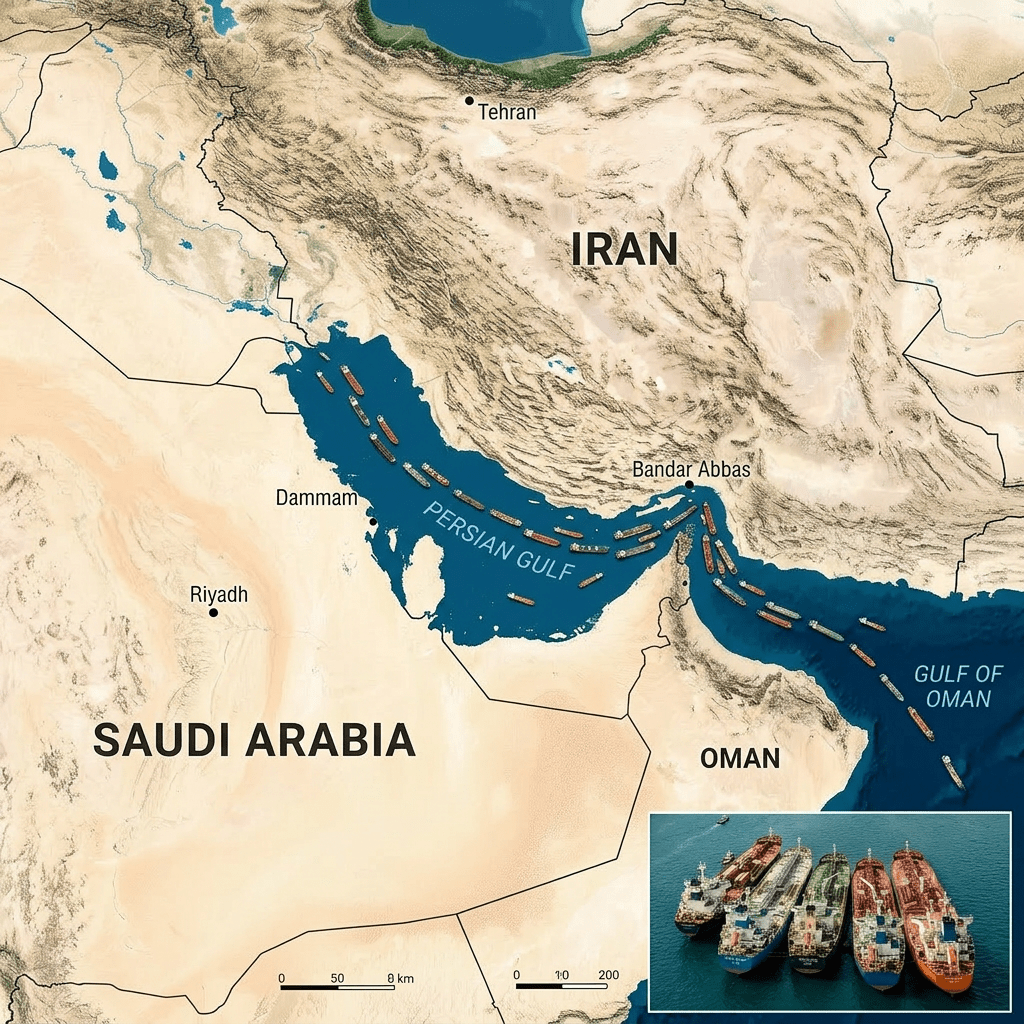
Current data shows that energy security is not merely an abstract concern but a structural constraint on industrial growth. Oil and gas still account for nearly 60% of global energy consumption, while regions such as the European Union depend on imports for approximately 57% of their energy needs. At the same time, nearly 20% of global oil flows pass through the Strait of Hormuz, making the system inherently fragile.
Recent disruptions have demonstrated that supply shocks can remove over 10 million barrels per day from global markets and trigger fuel price increases of up to 70%, with immediate consequences for manufacturing costs, food supply, and economic stability (International Energy Agency, 2025).
Market Diversification
Protectionism necessitates broader market engagement beyond traditional Western economies. Companies such as Tesla, Inc. have pursued geographic diversification, expanding into Asia and other emerging markets. This aligns with international business strategies focused on risk spreading and market expansion.
Digitalization for Visibility and Agility
Digital transformation enhances supply chain resilience by improving visibility and responsiveness. Supply chain networks must be digitally mapped, monitored, and integrated to enable real-time decision-making during disruptions.
End-to-end visibility is no longer optional—it is a prerequisite for effective risk management in complex global systems.
Financial and Risk Management
Volatility in energy prices, currencies, and logistics costs necessitates robust financial strategies. Fuel hedging practices by firms in the airlines illustrate the application of financial risk management tools. Such strategies help reduce earnings volatility, protect firm value, and ensure business continuity in uncertain environments.
A New Strategic Mindset
What we are witnessing is not a temporary adjustment, but a structural shift in corporate behavior. Firms are no longer optimizing for cost alone—they are redesigning operations for resilience.
The Middle East crisis has revealed how deeply interconnected energy, logistics, and geopolitics have become. Companies are being forced to respond simultaneously on operational, financial, and strategic fronts. Those with diversified supply chains, strong pricing power, and energy flexibility are better able to absorb shocks, while others remain vulnerable.
The divide between resilient and exposed firms is becoming increasingly visible—and increasingly consequential.
Related Posts
- Building Resilience in Supply Chains: Strategies for Disruption
- Comprehensive Guide to Supplier Assessment
- Vision 2020 Success and Failures (Researched by AI)
Enjoyed this post? Subscribe to receive new articles on supply chain and global business — straight to your inbox.


Leave a Reply