There are many factors that can contribute to excellence in manufacturing. Manufacturing any product itself comprises of many interdependent systems. How do we ensure that the systems are coordinated? This article tries to provide some of the answers that you might be looking for.
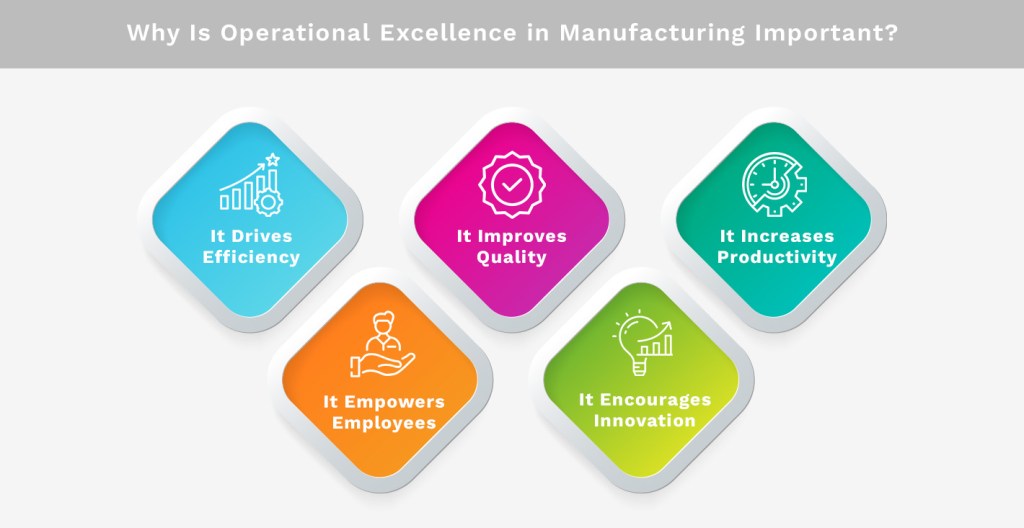
(Source: https://www.kohezion.com/blog/operational-excellence-in-manufacturing)
A system refers to an organized set of interconnected components or processes. They work together to achieve a specific outcome. This leads to producing the final product. Some of them are:
- Input Resources: Raw materials, labor, machinery, energy, and information.
- Processes: Activities in product design, engineering, procurement, assembly, testing, and quality assurance and control.
- Outputs: The finished goods itself, as well as any by-products or waste.
- Feedback Mechanism: Information used to adjust processes to improve efficiency, quality, or productivity.
A system in manufacturing aims to transform inputs into finished products efficiently, ensuring consistency, quality, and minimal waste. There will be systems for production, inventory management, quality management, maintenance, production planning and control, and customer complaints and warranty. It involves efficiently managing various activities and subsystems. This includes systems in supply chain management, production and operations, and quality management. All tasks are organized and well-coordinated.
A systematic and coordinated way of all manufacturing systems calls for the arrangement and systematically organizing all elements and activities of all the subsystems and systems so they work together efficiently and effectively. Some of the key points are:
- Synchronizing Activities: Ensuring that all parts of the production process—such as material procurement, production scheduling, quality control, and logistics—are aligned to avoid delays or inefficiencies. For example, materials need to arrive just as they are needed on the production line, avoiding idle time or inventory buildup.
- Integrated Communication: Establishing clear, real-time communication channels between different departments, such as procurement, production, and quality control, so everyone has access to the necessary information and can respond quickly to changes. This minimizes errors and ensures consistency in output.
- Holistic Planning: Taking a systems-level view to plan and execute processes so that each step supports the others. Production planning should take into account the availability of resources, machine capacity, labor availability, and demand requirements, ensuring that every element supports the efficient transformation of inputs into finished goods.
- Feedback Loop: Using continuous and prompt feedback from various stages of production to make timely adjustments. For example, if a quality problems is detected and identified in production lines, countermeasures and actions must be immediately upstream to stop temporarily the defects while searching for long term solutions to the product.
- Multi-Functional Collaboration: Involving different functions—such as design, process engineering, production, delivery and logistics, and quality assurance and control—in the planning and decision-making processes, to ensure all aspects and impacts are considered and potential problems are addressed proactively.
Managing these in a coordinated way will result in a much effective manufacturing system. Thus, achieving high quality products and processes, and at the same time minimizing waste and inefficiencies. Why pass inefficiencies to customers when you can reduce costs of poor quality, and make your products much cheaper?
Building and designing systems for excellence in your organizations is an art and engineering that needs greater attention.

 Quality From Classroom to Our Life
Leave a comment